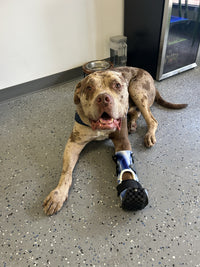
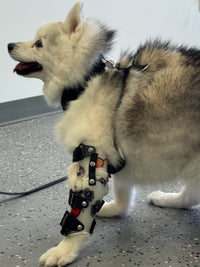
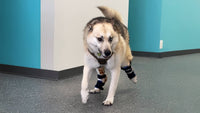
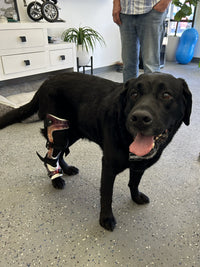
Added stability and support to a painful or unstable joint
Your pet's elbow is painful or unstable, and you're looking for options. You're in the right place. Here's what this brace does, how it works, and how we take it from there.

Every pet is different, and so is every device. We design and make each brace and prosthetic around the pet’s own needs.
A custom elbow brace is a support vacuum formed to an impression of an animal's own leg, made for mild to moderate elbow instability. It adds stability and support to a painful or unstable joint, helping improve comfort and mobility.
Last updated:
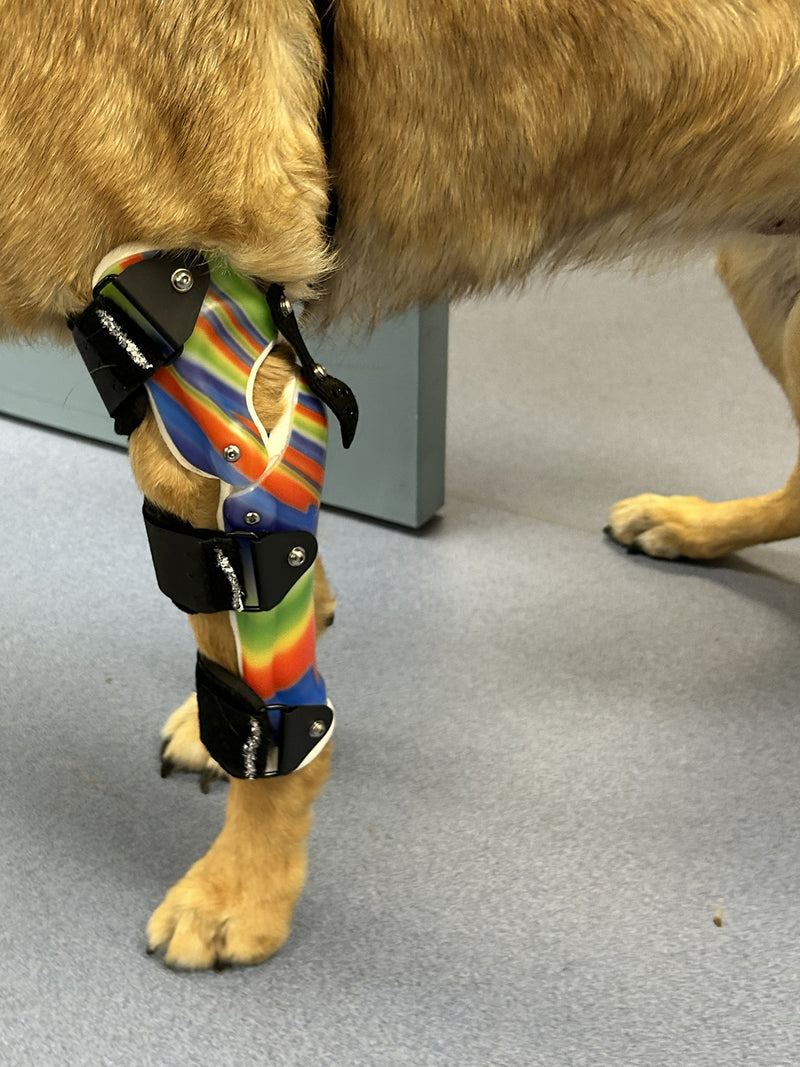
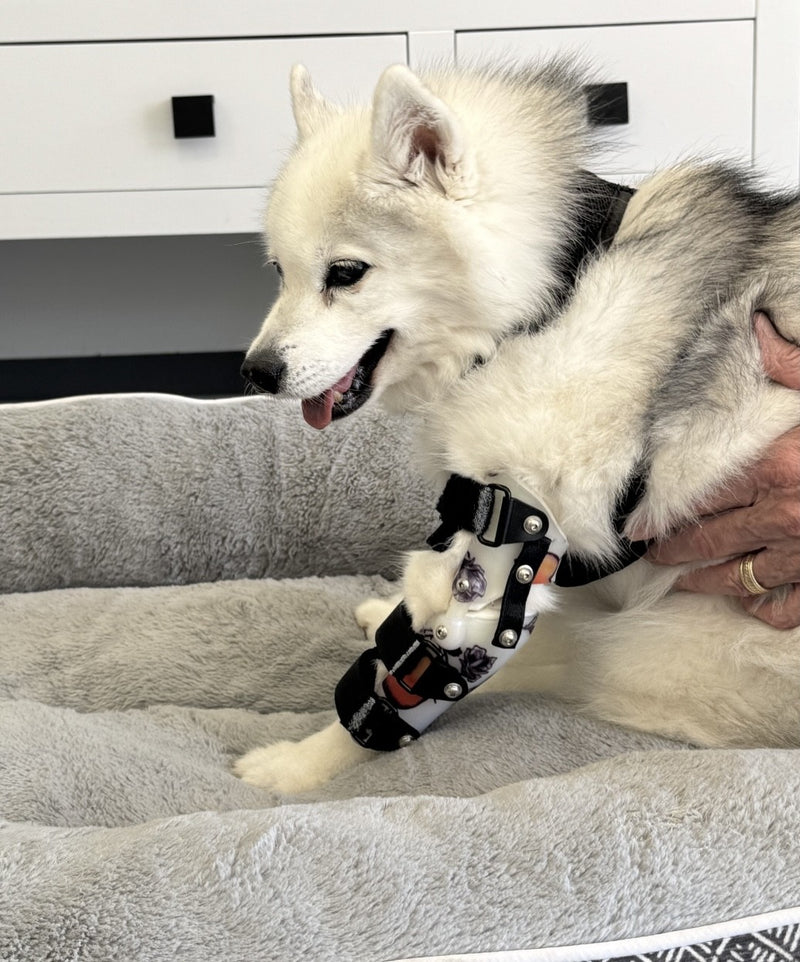
Your pet's elbow is painful or unstable, and you're looking for options. You're in the right place. Here's what this brace does, how it works, and how we take it from there.
A custom elbow brace can help when:
Severe dysplasia isn't a fit for a brace. There's no simple line between moderate and severe, so the photos, videos, and details you and your vet send help us determine whether a brace can help. A Case Manager reviews each case with your vet.
Fill out our form with the details. We'll contact you first, then your vet. A veterinarian's referral is required for a custom brace, but you don't have to work out that step alone. If your vet hasn't worked with mobility devices before, we'll help them consider orthotics as a treatment option for your pet.
A Case Manager evaluates your pet's history and condition with your vet to see whether a custom brace can best support your pet's mobility and quality of life. You get a straight answer, including when a custom brace isn't the right fit.
It's a cast or scan of your pet's leg, with our team guiding your vet through every step. You won't have to measure or guess anything.
Fabrication and quality review happen entirely at OrthoPaws. It takes about four to six weeks once your paperwork, casting materials, and payment or approved payment plan are in.
Your vet fits the brace, with virtual consults and real-time guidance available from our team. A break-in period with small adjustments is normal. Your dedicated Case Manager stays with you for as long as your pet wears the brace.
More comfort and confidence on walks, at play, and in everyday life. Every brace is designed with your pet's mobility and quality of life in mind.
You never have to travel to us. We work with you and your vet remotely in the US, Canada, Australia, and around the world.
Tell us about your pet and we'll take it from there.
Families come to us for different reasons. Surgery may be too expensive, or not an option because of age, another health condition, or risk. Some want to try a conservative approach first, others need support after surgery, and some have already tried a store-bought brace that didn’t help.
Over-the-counter braces are designed for general use, not for the specific support your pet needs, which depends on their condition and anatomy. An OrthoPaws brace is designed around your pet’s specific anatomy and addresses their vet’s specific targets for support and treatment, while accounting for your pet’s individual fit and movement. This matters because a brace that slips, puts pressure in the wrong places, or doesn’t provide the right support may not help your pet move as intended. A custom brace is built differently from the start:
Whether a brace, surgery, or both is right is a decision for you and your vet. A Case Manager reviews it with your vet and gives you an honest answer, including when a custom brace isn’t the right fit.
OrthoPaws is a veterinary orthotics and prosthetic provider working with vets and pet owners in the US, Canada, Australia, and around the world. Custom braces aren't sold off the shelf. Each one starts with a veterinarian's referral, and you don't have to figure out that step alone. Fill out our form and we'll work out the next step together. We contact you first, then your vet, and if your vet hasn't worked with mobility devices before, we'll help them consider orthotics as a treatment option for your pet.
It depends on your pet's case, and a Case Manager reviews it with your vet. A brace helps with mild to moderate elbow problems. Dogs with severe dysplasia, or a break in the elbow or the bones next to it, aren't candidates. Size alone doesn't decide it: what matters is whether the brace can sit securely at the top of the leg, near the armpit, and whether the instability is within what a brace can support. You'll put the brace on and take it off, so your pet needs to be comfortable having the leg handled. Pets who are very nervous or reactive may need another approach.
No, you don't measure anything. The brace is made from an impression of your pet's leg, taken as a cast or scan, and our team guides your vet remotely, wherever you are. At the fitting, you'll learn how to put the brace on and take it off. We stay involved after the fitting too, through function review and any adjustments needed.
Yes, for the right case. The brace is made for mild to moderate elbow dysplasia, and it can give ongoing support for arthritis (OA/DJD). A Case Manager reviews each case with your vet to confirm the right design.
Possibly. A custom brace is designed around your dog's specific condition and anatomy, but the brace itself is only part of the picture. The right fit, guidance from your vet, and follow-up from our team all matter. Your dedicated Case Manager stays with you from the first conversation through fitting and adjustments, helping you and your vet work through the process. Tell us what you tried and what happened. We'll review your pet's case and give you an honest answer, including when a custom brace isn't the right fit.
An elbow brace adds stability and support to a painful or unstable joint. That can help your pet feel more comfortable and confident using the limb, and for some pets it improves mobility. Your vet and our Case Manager can tell you what to expect in your pet's case.
Sometimes. A custom brace can complement other treatments, support your pet before and after a procedure, or offer an alternative when surgery isn't an option. Whether to have surgery is a decision for you and your vet, and we help you see what a custom brace can and can't do for your pet.
Yes. It's made from waterproof, medical-grade materials, so rain, water play, and water treadmill sessions are fine. Let every part dry completely before the next wear.
It depends on your pet and how active they are. We recommend a refurbishment every 12 to 24 months, or sooner depending on use and conditions. A refurbishment rebuilds the brace with new straps, pads, foam lining, and tread.
Custom braces start at $1,550. Many pet insurance plans reimburse for custom devices, depending on your plan. We'll give you an itemized invoice to submit to your insurer, and payment plans may be available for qualifying cases. If you've been quoted for surgery, let us know. We'll walk you through what a custom brace involves, so you can explore your options with a clearer picture of the costs and process.
Yes. A custom elbow brace can be made for dogs, cats, and other animals, including goats, pigs, and llamas. Each case is reviewed individually with your vet to see whether a custom brace is appropriate.
That depends on your dog's condition, mobility, and how they respond to the brace. Our goal is to help your dog move more comfortably and take part in the activities they enjoy, whether that means going for walks, playing, or exploring outdoors. Our braces are waterproof and designed for everyday use. Your Case Manager and vet will guide you through the adjustment period and any fitting changes needed along the way.
Yes. Several members of our team previously supported OrthoPets clients. We can evaluate your pet's device remotely from photos and videos and recommend a repair, an adjustment, a refurbishment, or a new device. Repairs, adjustments, and refurbishments don't need a veterinary referral. A new custom device does, and we'll guide you through that step.
Quick Order is for cases we've already reviewed with you. New here? Start with "Start your pet's mobility journey".
A custom elbow orthosis for mild to moderate elbow instabilities, triceps tendon injuries, and post-op support and reloading. Dacron motion-limiting straps allow a gradual and controlled return of motion, and metal bars provide rigid immobilization when indicated.
A Case Manager reviews it and replies with observations and next steps, typically within one business day.
There's no fixed line between moderate and severe dysplasia. We rely on the media and the referral form to determine candidacy.
We stay with you from candidacy to follow-up, wherever you are. Casting can be guided remotely or done on site with your team, so you don't need to know how to take the impression yourself. Client education and video calls are available five days a week, by appointment. Candidacy visits, fittings, and follow-ups bill as your own appointments, so the relationship with your client stays yours.
| Feature | What it does |
|---|---|
| Polypropylene shell | Vacuum formed to a custom mold from the patient's impression, for rigid contact and support where needed. |
| Closed-cell Aliplast foam liner | Human-grade, contoured for an intimate fit, and does not absorb water. |
| Velcro straps and neoprene pads | Secure the device and spread force against the limb, and can adapt to changes in muscle mass. The pads protect the limb from strap edges. |
| Custom reliefs | Built in for bony prominences, to prevent pressure sores. |
| Polycentric hinges | Controlled range of motion and shock absorption that follow the joint's natural motion, and limit shear forces with movement. |
| Dacron straps or metal bars | Dacron limits motion and allows a gradual return of motion. Metal bars give rigid immobilization when indicated and can be swapped for Dacron. |
| Waterproof, adjustable construction | Safe in the water treadmill and in water during activity. Allow every component to dry completely before the next wear. Our fabrication team can adjust the device as the patient's needs change. |
It depends on the case, and that's the honest answer. Mild to moderate elbow instability, dysplasia, OA/DJD, and triceps tendon injuries are common indications. Severe dysplasia, a fracture of the olecranon, humerus, or proximal radius or ulna, and limited axillary access for a humeral cuff rule a patient out. Candidacy depends on whether we can access the axillary space and whether the instability falls within the scope of what we can support, and the media and referral form help us determine it. Patients who can't be handled regularly aren't candidates, and very nervous or reactive patients are reviewed with caution. A Case Manager looks at every case personally instead of running it against a checklist. Submit the case along with your goals for the patient, and you'll get a straight answer, including an honest one if it's not a good fit.
Sometimes, case by case. We can trade some support for increased function in the device, and a Case Manager helps you weigh that for the case.
Yes. Every patient interacts with their device a little differently, so adjustments are a normal part of the process, not a sign that something went wrong. Photos or video of how the patient moves help us fine-tune the fit. Every case gets a Case Manager, from candidacy through fitting and the adjustments that come with the break-in period, and that same Case Manager stays your point of contact for as long as you're using the device.
It depends on the patient. We recommend a refurbishment every 12 to 24 months, or sooner depending on patient use and conditions. A full refurbishment replaces the straps, pads, foam lining, tread, and hardware, so the brace is rebuilt.
Yes. OrthoPaws includes team members who previously supported OrthoPets clients. If your patient has a device that needs repair, adjustment, or replacement, we can evaluate it, in most cases remotely from photos or videos, and recommend an adjustment, replacement parts, a refurbishment, or a new device. No vet referral is required for repairs, adjustments, or refurbishments. A new custom device needs a veterinary impression for an accurate fit.
Transitioning from a VOP partner? · Submit a case for review
A Case Manager reviews it and replies with observations and next steps, typically within one business day. Quick Order is for cases we've already reviewed with you. New case? Use "Submit a case for review".