
Custom Carpal (Wrist) Brace for Dogs
A custom carpal (wrist) brace is a support vacuum formed to an impression of an animal's own leg, used for carpal hyperextension, wrist instability and ligament injuries, and paw knuckling. It supports and stabilizes the wrist, helping improve comfort and mobility.
Last updated:
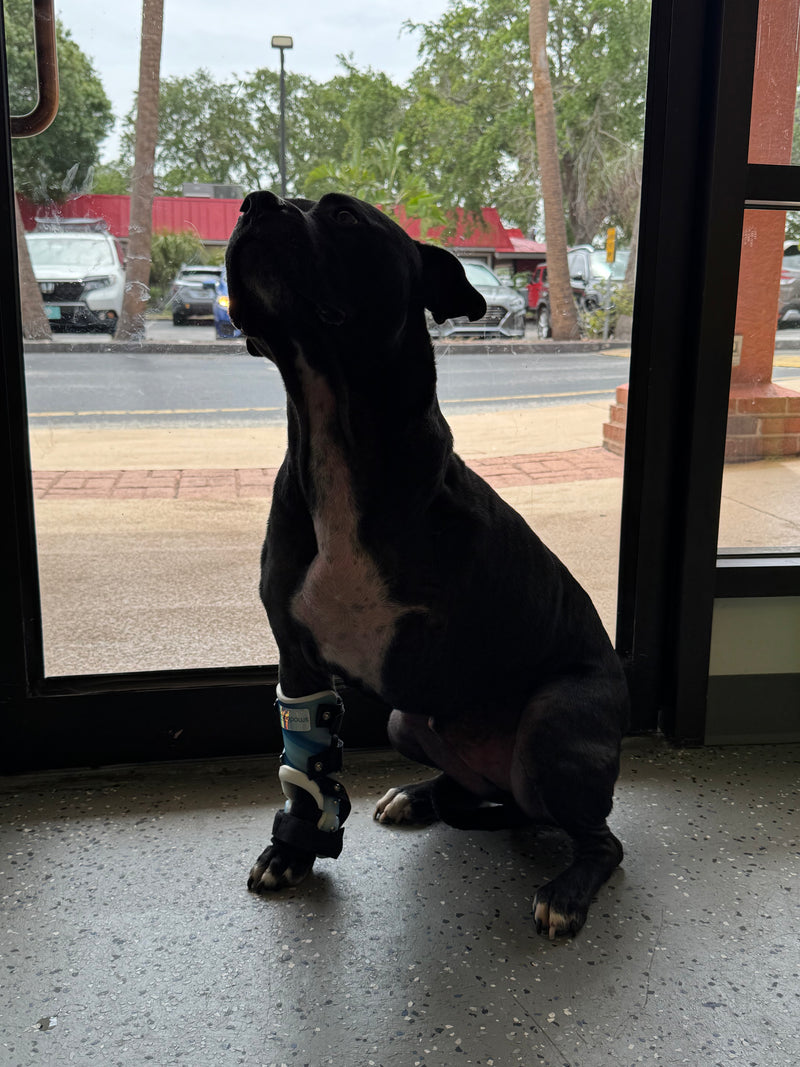
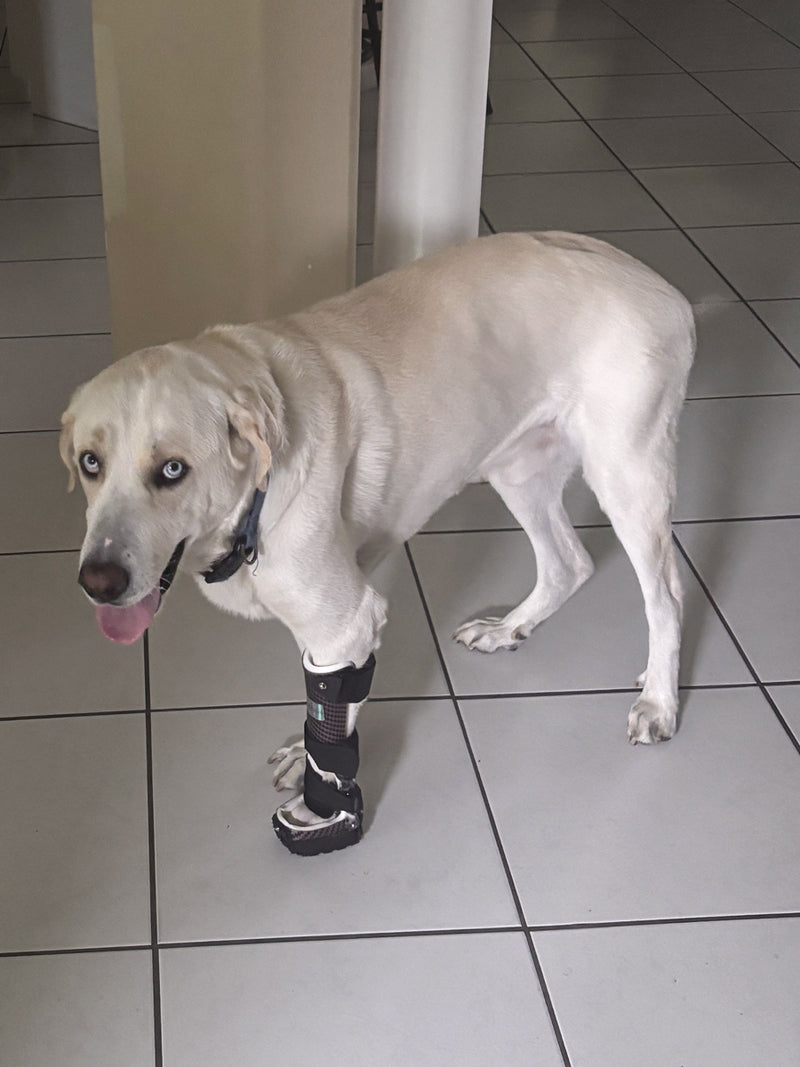
For pet parents
Your pet's wrist is dropping or giving way, and you're looking for options. You're in the right place. Here's what this brace does, what to expect, and how we take it from there.
Why would a dog need a wrist brace?
A custom carpal brace can help when:
- The wrist sinks lower than it should as your pet stands or walks (carpal hyperextension)
- The joint gives way or moves more than it should, including after a ligament injury
- The paw folds under during a step (knuckling)
- Your pet needs support after surgery or plate removal, instead of bandages and splints
- A tendon injury needs the wrist held steady at first, then loaded gradually
- Toes are missing or injured, and weight bearing needs to be more even
Some congenital differences and some nerve-related weakness in the front leg are reviewed case by case.
What to expect
- Tell us about your pet. Fill out our form with the details. We'll contact you first, then your vet. A veterinarian's referral is a must for a custom brace, but you don't have to work out that step alone. If you need a vet, we can connect you with a partner veterinarian near you.
- We review the case with your vet. A Case Manager looks at your pet's history and needs with your vet, so you know which brace is recommended and what happens at each step.
- An impression of your pet's leg is taken as a cast or scan, with our team guiding your vet. You don't measure anything.
- We make the brace, and fabrication and quality review happen entirely at OrthoPaws. It takes about four weeks once payment, paperwork, and casting materials are in. Then we work with your vet through the fitting, follow-up, and any adjustments. A break-in period with small adjustments is normal, and your vet stays at the center of your pet's care.
She has adapted and life is much easier than I anticipated it would be doing this everyday. Thanks to all of you for getting us to this point. Can't thank you enough.
Tell us about your pet and we'll take it from there.
How is a custom brace different from a store-bought one?
Families come to us for different reasons. Surgery may be too expensive, or not an option because of age, another health condition, or risk. Some want to try a conservative approach first, others need support after surgery, and some have already tried a store-bought brace that didn't help. A custom brace is built differently from the start:
- Made from an impression of your pet's own leg, taken as a cast or scan
- Built with medical-grade materials: a polypropylene shell, a closed-cell foam liner, and neoprene pads
- Relief areas for the dew claw and bony points protect the skin
- Adjustable as your pet's muscles and needs change
Whether a brace, surgery, or both is right is a decision for you and your vet. A Case Manager reviews it with your vet and gives you an honest answer, including when a custom brace isn't the right fit.
Questions we hear most
Where can I buy a custom carpal brace, and do I need a vet's referral?
OrthoPaws is a veterinary orthotics and prosthetic provider working with vets and pet owners across the US and around the world. Custom braces aren't sold off the shelf. Each one starts with a veterinarian's referral, and you don't have to figure out that step alone. Fill out our form and we'll work out the next step together. We contact you first, then your vet, or connect you with a partner veterinarian near you.
How do I know if my dog is a good candidate for a custom carpal brace?
It depends on your pet's case, and a Case Manager reviews it with your vet. You'll put the brace on and take it off, so your pet needs to be comfortable with having the leg handled. Pets who are very nervous or reactive when the leg is touched may need another approach.
Do I need to measure my dog, and how is the brace fitted?
No, you don't measure anything. The brace is made from an impression of your pet's leg, taken as a cast or scan, and our team guides your vet remotely, wherever you are. Families near Palm Harbor, Florida can also have us take the impression, photos, and measurements at our clinic. At the fitting, you'll learn how to put the brace on and take it off.
Can a custom carpal brace be used instead of surgery?
Sometimes. A custom brace can be used instead of surgery, alongside it, or during recovery. Whether to have surgery is a decision for you and your vet, and we help you see what a custom brace can and can't do for your pet.
Can a dog wrist brace help with carpal hyperextension or ligament injuries?
Yes. This brace is designed for carpal hyperextension, from mild to severe, and for wrist instability, including ligament injuries. A Case Manager reviews each case with your vet to confirm the right design.
How long should my dog wear the brace each day?
Every pet adjusts at their own pace. We recommend short, positive wear sessions that build up gradually. Your vet and our Case Manager help you set the schedule and tell you what to watch for, such as rubbing or a change in how your pet moves. If you notice rubbing, tell your vet. Photos or a short video help us recommend the right adjustment.
Is the brace waterproof?
Yes. It's made from waterproof, medical-grade materials, so rain, water play, and water treadmill sessions are fine. Let every part dry completely before the next wear.
How long does a custom carpal brace last?
It depends on your pet and how active they are. We recommend a refurbishment every 12 to 24 months, or sooner depending on use and conditions. A refurbishment rebuilds the brace with new straps, pads, foam lining, and tread.
How much does a custom carpal brace cost, and does pet insurance cover it?
Custom braces start at $1,550, and shipping isn't included. Payment plans may be available for qualified cases. Many pet insurance plans reimburse for custom devices, but coverage depends on your plan, so check with your insurer before you decide. Our team can help with payment plans and with submitting for insurance reimbursement. If you've been quoted for surgery, tell us, and we'll explain what the brace involves so you can compare.
Can cats or other animals use a carpal brace?
Yes. OrthoPaws works with dogs, cats, and other animals, including goats, pigs, and rabbits. Cats and other species are reviewed case by case with your vet.
My dog has an OrthoPets brace that needs attention. Can OrthoPaws help?
Yes. Several members of our team previously supported OrthoPets clients. We can evaluate your pet's device remotely from photos and videos and recommend a repair, an adjustment, a refurbishment, or a new device. Repairs, adjustments, and refurbishments don't need a veterinary referral. A new custom device does, and we'll guide you through that step.
Quick Order is for cases we've already reviewed with you. New here? Start with "Start your pet's mobility journey".
For vet professionals and rehab centers
An alternative to arthrodesis, or an option after a failed one
A custom carpal brace for sagittal, frontal and transverse plane instabilities of the carpus: carpal hyperextension, collateral ligament injuries, SDF/DDF injuries, paw knuckling, and support after partial arthrodesis or plate removal. It gives initial immobilization with progressive reloading of injured tendons, and serves as a post-op alternative to bandaging/splints. We work with you and your team so you can take on these cases with more confidence.
Submit the case online at no charge. A Case Manager reviews it and replies with observations and next steps, typically within one business day.
Clinical indications
- Sagittal, frontal, and transverse plane instabilities of the carpus
- Carpal hyperextension
- Varus or valgus deviation
- Congenital deformation and abnormalities
- Some brachial plexus cases
- Instabilities of the paw and toes, including missing toes
- Superficial and deep digital flexor (SDF/DDF) injuries
- Partial arthrodesis and plate removal
- Medial and lateral collateral ligament injuries
- Paw knuckling
- Fractures of the toes or antebrachium, and subluxation
- Post-operative alternative to bandaging and splints
When this device is the right call
- An alternative to arthrodesis, or an option after a failed arthrodesis
- Mild to severe carpal hyperextension
- Initial immobilization with progressive reloading of injured tendons
- Immobilization of complicated or non-healing fractures
- Restoring normal weight bearing for missing digits
Who is not a candidate
- Patients who can't be handled regularly or don't tolerate manipulation of the affected limb
- Extremely nervous or reactive patients, reviewed with caution
- Some congenital abnormalities or conformations where a device would create more problems than the patient has now
- Feline patients, reviewed case by case
- Cases that need a humeral cuff where there is no axillary access
How OrthoPaws enhances your practice
We stay with you from candidacy to follow-up, wherever you are. Casting can be guided remotely, done on site with your team, or handled at our Palm Harbor clinic, so you don't need to know how to take the impression yourself. Candidacy visits, fittings, and follow-ups bill as your own appointments, so the relationship with your client stays yours.
Design features
| Feature | What it does |
|---|---|
| Polypropylene shell | Vacuum formed to a custom mold from the patient's impression, for rigid contact and support where needed. |
| Closed-cell Aliplast foam liner | Human-grade, contoured for an intimate fit, and does not absorb water. |
| Velcro straps and neoprene pads | Secure the device and spread force against the limb, and can adapt to changes in muscle mass. The pads protect the limb from strap edges. |
| Custom reliefs | Built in for dew claws, the accessory carpal bone (ACB), and other bony prominences, to prevent pressure sores. |
| Polycentric hinges | Controlled range of motion and shock absorption that follow the joint's natural motion. |
| Dacron straps or metal bars | Dacron limits motion and allows a gradual return of motion. Metal bars give rigid immobilization when indicated and can be swapped for Dacron. |
| Internal paw pedestal and external wedge | The pedestal supports the main paw pad and gives the toes grip. The removable wedge accommodates tight digits and aligns the ground reaction force vector until it can come off. |
| Caudal kickback | Keeps the patient from collapsing back in the device and the limb aligned under load. |
| Crepe rocker bottom and tread | A level weight-bearing surface with a smooth rocker from stance through propulsion, plus traction. |
| Waterproof, adjustable construction | Safe in the water treadmill and in water during activity. Allow every component to dry completely before the next wear. Our fabrication team can adjust the device as the patient's needs change. |
Questions we hear most
Is my patient a viable candidate for a custom carpal brace?
It depends on the case, and that's the honest answer. Carpal hyperextension, carpal instability, collateral ligament injuries, and paw knuckling are common indications. Patients who can't be handled regularly or don't tolerate manipulation of the limb aren't candidates, and very nervous or reactive patients are reviewed with caution. A Case Manager looks at every case personally instead of running it against a checklist. Submit the case along with your goals for the patient, and you'll get a straight answer, including an honest one if it's not a good fit.
Can a carpal brace be used instead of arthrodesis, or after it?
Yes. A custom carpal brace can be an alternative to arthrodesis, or an option after a failed arthrodesis. It can also be used instead of surgery, alongside it, or as part of rehabilitation after surgery. That decision stays with you and the patient's owner, and we help you evaluate the option.
Are adjustments normal after fitting?
Yes. Every patient interacts with their device a little differently, so adjustments are a normal part of the process, not a sign that something went wrong. Photos or video of how the patient moves help us fine-tune the fit. Every case gets a Case Manager, from candidacy through fitting and the adjustments that come with the break-in period, and that same Case Manager stays your point of contact for as long as you're using the device.
How long will the brace last, and is it a long-term treatment?
It depends on the patient. We recommend a refurbishment every 12 to 24 months, or sooner depending on patient use and conditions. A full refurbishment replaces the straps, pads, foam lining, tread, and hardware, so the brace is rebuilt.
Can OrthoPaws evaluate or service a carpal brace made by OrthoPets?
Yes. OrthoPaws includes team members who previously supported OrthoPets clients. If your patient has a device that needs repair, adjustment, or replacement, we can evaluate it, in most cases remotely from photos or videos, and recommend an adjustment, replacement parts, a refurbishment, or a new device. No vet referral is required for repairs, adjustments, or refurbishments. A new custom device needs a veterinary impression for an accurate fit.
Transitioning from a VOP partner? · Submit a case for review
Quick Order is for cases we've already reviewed with you. New case? Use "Submit a case for review".